
 Wildlife
of Nepal
Tibetan Snowcock
Pheasants, Partridges & Quails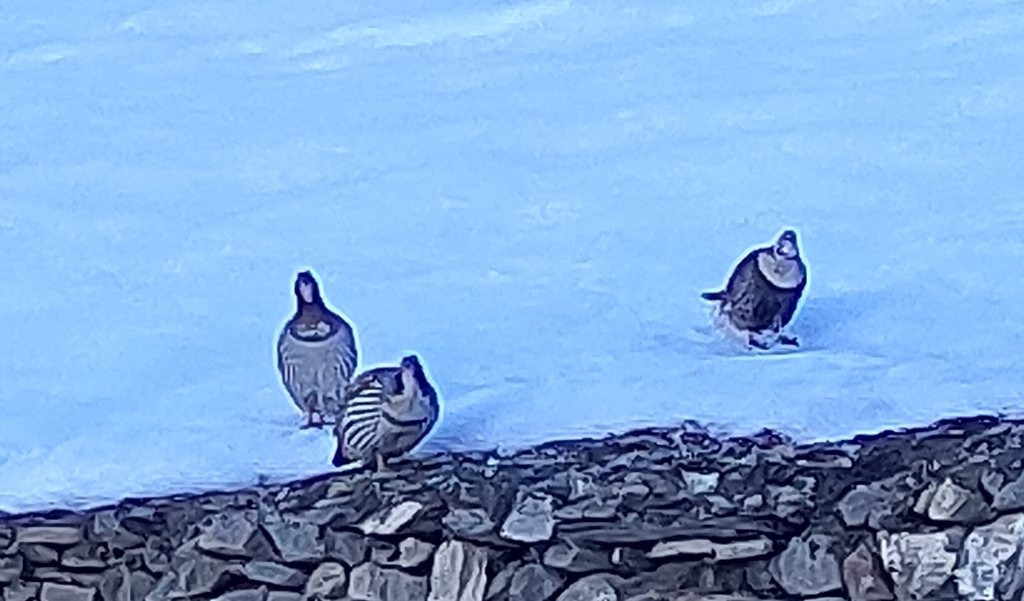
Photo: (c) przese, some rights reserved (CC BY) · CC-BY (May be cropped or resized)
Tetraogallus tibetanus
Basic stats
Habitat
High-altitude regions of the western Himalayas and Tibetan Plateau
Clutch size
4–6 eggs
The Tibetan snowcock is found at high altitude in the western Himalayas and the Tibetan Plateau, where it overlaps in part with the larger Himalayan snowcock. It has a grey head and neck with a white crescent patch behind the eye, a white chin, throat and breast with two grey breast bands, and a white underside with black stripes. In flight the secondaries show a broad white trailing edge (Wikipedia, general species account).
The flight is swift and often accompanied by whistling calls. On landing, snowcocks shake their tails several times. They call in the morning and evening and are quiet in the middle of the day, when one or more adults mount boulders to keep watch and warn the flock with loud, prolonged whistles. Four to six eggs are laid. The sources opened do not say where it occurs in Nepal.
Quick answers
- What habitat does the Tibetan Snowcock live in?
- High-altitude regions of the western Himalayas and Tibetan Plateau
- How many eggs does the Tibetan Snowcock lay?
- 4–6 eggs
In Nepal
GBIF holds 364 records of the Tibetan Snowcock from 6 protected areas in Nepal, dated 1949 to 2026. Most come from Sagarmatha National Park and Annapurna Conservation Area.
Where it has been recorded
- Sagarmatha National Park 244 records, latest 2026
- Annapurna Conservation Area 57 records, latest 2024
- Langtang National Park 42 records, latest 2024
- Makalu Barun National Park 12 records, latest 2023
- Kanchenjunga Conservation Area 5 records, latest 2022
- Manaslu Conservation Area 4 records, latest 2026
Covered in our place guides: Sagarmatha National Park, Annapurna Conservation Area, Langtang National Park, Makalu Barun National Park, Kanchenjunga Conservation Area.
Also in our other guides: Bhutan.
Records: GBIF occurrence data matched to park boundaries (© OpenStreetMap contributors, ODbL; Wikidata). Counts show recording effort, not how common the species is.