
 Wildlife
of Nepal
Greater Coucal
Cuckoos & Coucals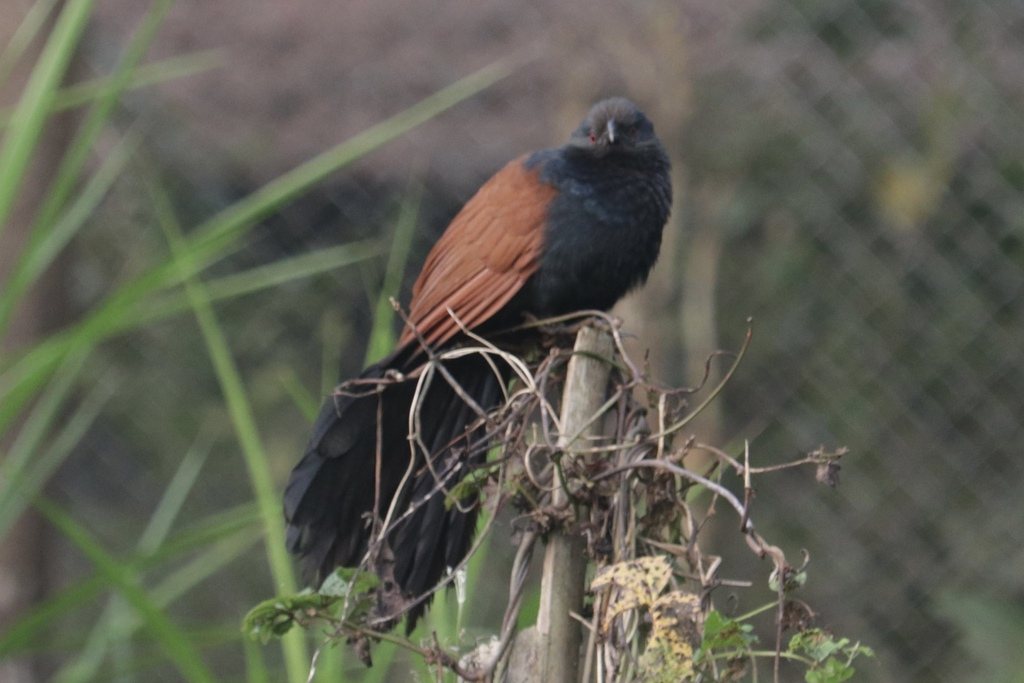
Photo: (c) sam-rajnikant, some rights reserved (CC BY) · CC-BY (May be cropped or resized)
Centropus sinensis
Basic stats
Diet
Insects, eggs and nestlings of other birds; also fruit and seeds
Habitat
Jungle, cultivation and urban gardens
Range
Indian subcontinent and Southeast Asia
Clutch size
3–5 eggs
Size
48cm
The greater coucal, or crow pheasant, is a large, crow-like member of the cuckoo order, about 48cm long with a long tail. The head, upper mantle and underside are black glossed with purple, the back and wings chestnut-brown, and the eyes ruby red. Juveniles are duller, with spots on the crown and whitish bars below (Wikipedia, general species account).
Unlike most cuckoos it is not a brood parasite. It is a weak flier, often clambering through vegetation or walking on the ground as it forages for insects, eggs and nestlings of other birds, and it also eats fruit and seeds. It lives in habitats from jungle to farmland and town gardens, and its deep, resonant call is linked with omens in many parts of its range. Clutches are three to five eggs and chicks fledge in 18 to 22 days.
Quick answers
- What does the Greater Coucal eat?
- Insects, eggs and nestlings of other birds; also fruit and seeds
- What habitat does the Greater Coucal live in?
- Jungle, cultivation and urban gardens
- Where is the Greater Coucal found?
- Indian subcontinent and Southeast Asia
- How many eggs does the Greater Coucal lay?
- 3–5 eggs
- How big is the Greater Coucal?
- 48cm
In Nepal
GBIF holds 2,872 records of the Greater Coucal from 10 protected areas in Nepal, dated 1978 to 2026. Most come from Chitwan National Park and Koshi Tappu Wildlife Reserve.
Where it has been recorded
- Chitwan National Park 1,421 records, latest 2026
- Koshi Tappu Wildlife Reserve 710 records, latest 2026
- Bardiya National Park 264 records, latest 2025
- Shukla Phanta National Park 178 records, latest 2024
- Shivapuri Nagarjuna National Park 159 records, latest 2024
- Annapurna Conservation Area 52 records, latest 2024
- Raniban Forest (Pokhara) 49 records, latest 2024
- Parsa National Park 19 records, latest 2024
Plus 2 more sites.
Covered in our place guides: Chitwan National Park, Koshi Tappu Wildlife Reserve, Annapurna Conservation Area.
Seen on trips we host
- Nepal: mammal watching trip report Wise Birding Holidays, 2019
Also in our other guides: India, Malaysia, Sri Lanka, Sulawesi, Sumatra, Thailand, Vietnam.
Records: GBIF occurrence data matched to park boundaries (© OpenStreetMap contributors, ODbL; Wikidata). Counts show recording effort, not how common the species is.