
 Wildlife
of Nepal
Hog Deer
Deer & Chevrotains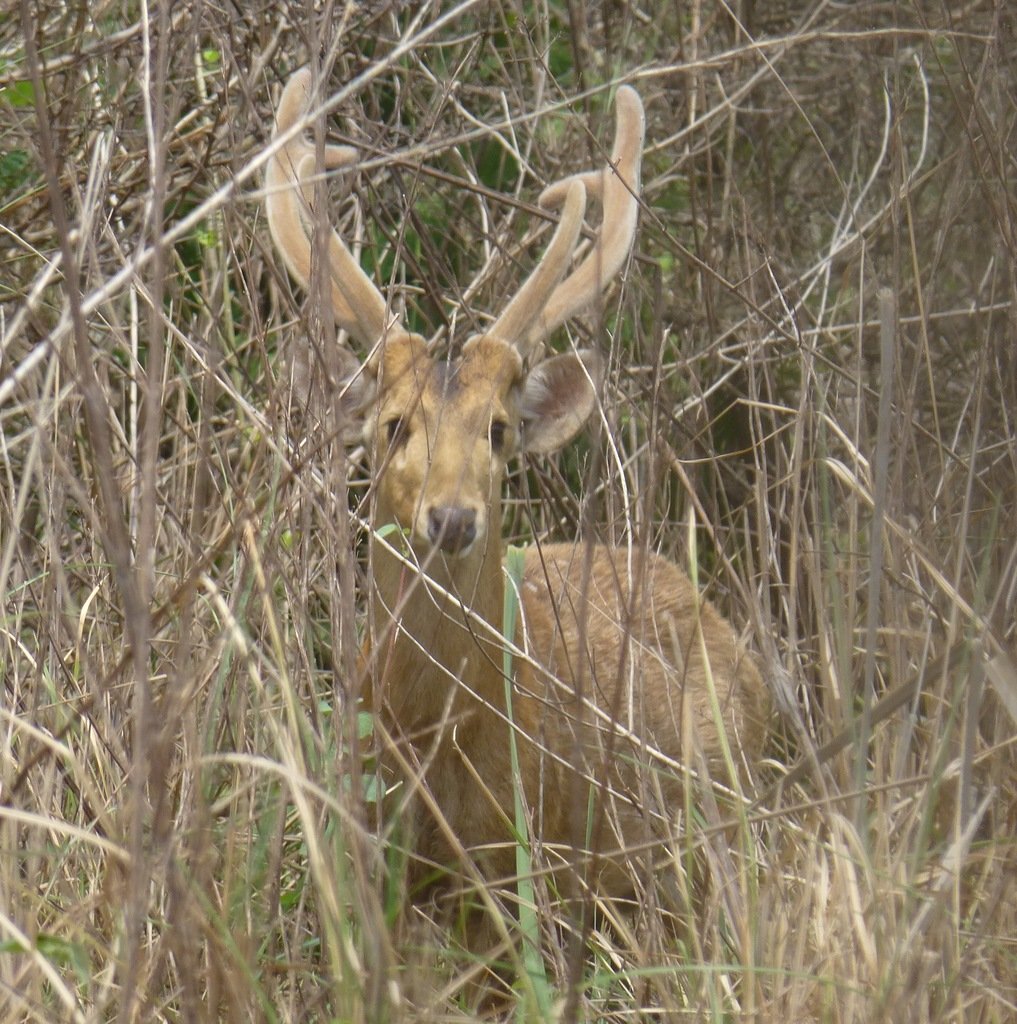
Photo: Sheelagh Halsey · CC-BY (May be cropped or resized)
Axis porcinus
Basic stats
Habitat
Grassland of the Indo-Gangetic Plain
Range
Indus valley in Pakistan, northern India, Nepal, southern Bhutan, Bangladesh, Myanmar and Yunnan
The Indian hog deer is a small deer native to the Indian subcontinent and Indo-Gangetic Plain. The ears are rounded, and older animals tend to become lighter in colour on the face and neck. The coat is thick and generally a uniform dark brown in winter, except for lighter underparts and legs (Wikipedia, general species account).
In late spring it changes to a rich reddish-brown summer coat, though timing varies between individuals. Many hog deer show a dark stripe from the head down the back of the neck and along the spine. Its range runs through northern India, Nepal, southern Bhutan, Bangladesh and Myanmar, and introduced populations exist in Australia, the United States and Sri Lanka. Nationally Endangered (Nepal National Red List 2011).
Quick answers
- What habitat does the Hog Deer live in?
- Grassland of the Indo-Gangetic Plain
- Where is the Hog Deer found?
- Indus valley in Pakistan, northern India, Nepal, southern Bhutan, Bangladesh, Myanmar and Yunnan
In Nepal
GBIF holds 68 records of the Hog Deer from 3 protected areas in Nepal, dated 1905 to 2025. Most come from Chitwan National Park and Shukla Phanta National Park.
Where it has been recorded
- Chitwan National Park 50 records, latest 2025
- Shukla Phanta National Park 10 records, latest 1905
- Koshi Tappu Wildlife Reserve 8 records
Covered in our place guides: Chitwan National Park, Koshi Tappu Wildlife Reserve.
Seen on trips we host
- Nepal: mammal watching trip report Jon Hall, 2016
- Wild Nepal: Bardia and Bhutan extension Royle Safaris, 2011
Also in our other guides: Bhutan.
Records: GBIF occurrence data matched to park boundaries (© OpenStreetMap contributors, ODbL; Wikidata). Counts show recording effort, not how common the species is.